
981: Who Owns the World’s Seeds with Bill McDorman
A chat with an expert on seeds.
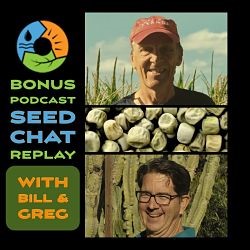
In This Seed Chat:
In this Podcast: This Seed Chat explores the growing consolidation of global seed ownership and the implications of patenting life. Farmer Greg and Bill McDorman dive into the history of seed patent law, the rise of corporate control, and the tension between industrial agriculture and traditional seed saving. They highlight global efforts, especially in Europe, to resist seed patents and protect biodiversity. The episode emphasizes seed saving as both a practical skill and a powerful act of resilience and autonomy.
Editor’s Note:
Key Topics
- Corporate consolidation of global seed ownership
- Seed patenting and intellectual property rights
- Supreme Court case Diamond v. Chakrabarty (1980)
- Plant Variety Protection Act (PVPA)
- Utility patents vs. plant breeder protections
- European coalition: No Patents on Seeds
- Role of NGOs and international advocacy
- Open Source Seed Initiative (OSSI)
- Center for Food Safety legal efforts
- ETC Group and global seed policy research
- Organic Seed Alliance publications
- Seed saving as resistance and resilience
- Genetic diversity and climate adaptation
- Industrial agriculture vs. small-scale seed saving
Key Questions Answered
Who controls the world’s seeds?
A small number of multinational corporations dominate the global seed market, controlling a significant percentage of commercial seed distribution. This concentration is driven by mergers, acquisitions, and patent protections that favor industrial agriculture.How did seed patenting become legal?
The 1980 Supreme Court ruling in Diamond v. Chakrabarty opened the door for patenting living organisms. This decision enabled utility patents on seeds, allowing companies to claim ownership over genetically modified—and later even conventionally bred—plants.What was the original compromise to protect seed breeders?
The Plant Variety Protection Act (PVPA) provided a 20-year protection period for breeders while still allowing farmers to save seeds and researchers to use protected varieties. This balance has been eroded by utility patents.Why are seed patents controversial?
Seed patents restrict farmers from saving seeds and limit other breeders from using patented genetics. This undermines traditional agricultural practices and reduces biodiversity.What is being done globally to resist seed patents?
Organizations like No Patents on Seeds in Europe mobilize public campaigns, monitor patent filings, and challenge approvals. Coalitions of NGOs are working to influence policy and raise awareness.What is the Open Source Seed Initiative?
OSSI is a movement that protects seeds from patenting by creating a legal framework that ensures varieties remain freely available for use, breeding, and saving.Why is seed saving important?
Seed saving preserves genetic diversity, strengthens local food systems, and gives growers autonomy. It’s a foundational practice that has sustained agriculture for over 10,000 years.Is seed saving difficult?
No—contrary to common belief, seed saving is simple at a small scale. The complexity often associated with it comes from industrial agriculture requirements, not backyard or community gardening.
Episode Highlights
- Global seed ownership is increasingly concentrated among a few corporations.
- The 1980 Supreme Court ruling enabled the patenting of life forms.
- The PVPA once balanced breeder rights with farmer freedoms.
- Utility patents now restrict both seed saving and research.
- European NGOs have mobilized hundreds of thousands against seed patents.
- Seed saving is accessible, resilient, and historically proven.
- Genetic diversity is critical for adapting to climate change.
- Local seed saving builds community and food sovereignty.
Resources
Join Live Seed Chats – https://seedchat.org Learn about seed freedom advocacy – https://www.no-patents-on-seeds.org Explore open-source seeds – https://osseeds.org Support legal advocacy – https://www.centerforfoodsafety.org No Patents On Seeds – https://www.no-patents-on-seeds.org/en Organic Seed Alliance – https://seedalliance.org/ A Guide to Seed Intellectual Property Rights – https://seedalliance.org/publications/a-guide-to-seed-intellectual-property-rights/ Penn Parmenter – https://www.pennandcordsgarden.com/ Seed The Untold Story – https://www.seedthemovie.com Email Bill at elmoclap@proton.me Canada National Farmers Union – Save Our Seed – https://www.nfu.ca/learn/save-our-seed/ Seed Change – https://weseedchange.org/etc Group – Research global seed policy — https://www.etcgroup.org

At least ten times a year we have a live Seed Saving Class with Bill McDorman, the former Executive Director of Rocky Mountain Seed Alliance, Ketchum, Idaho. He got his start in the bio-regional seed movement while in college in 1979 when he helped start Garden City Seeds. In 1984, Bill started Seeds Trust/High Altitude Gardens, a mail order seed company he ran successfully until it sold in 2013.
Come join us for the next live class, or catch up on our previous classes through our podcast episodes. Either way you will expand your seed knowledge and gain new perspectives on your food system.
Register anytime for the next event.
Register Here for the Monthly Seed Saving Class with Live Q&A
*Disclosure: Some of the links in our podcast show notes and blog posts are affiliate links and if you go through them to make a purchase, we will earn a nominal commission at no cost to you. We offer links to items recommended by our podcast guests and guest writers as a service to our audience and these items are not selected because of the commission we receive from your purchases. We know the decision is yours, and whether you decide to buy something is completely up to you.

